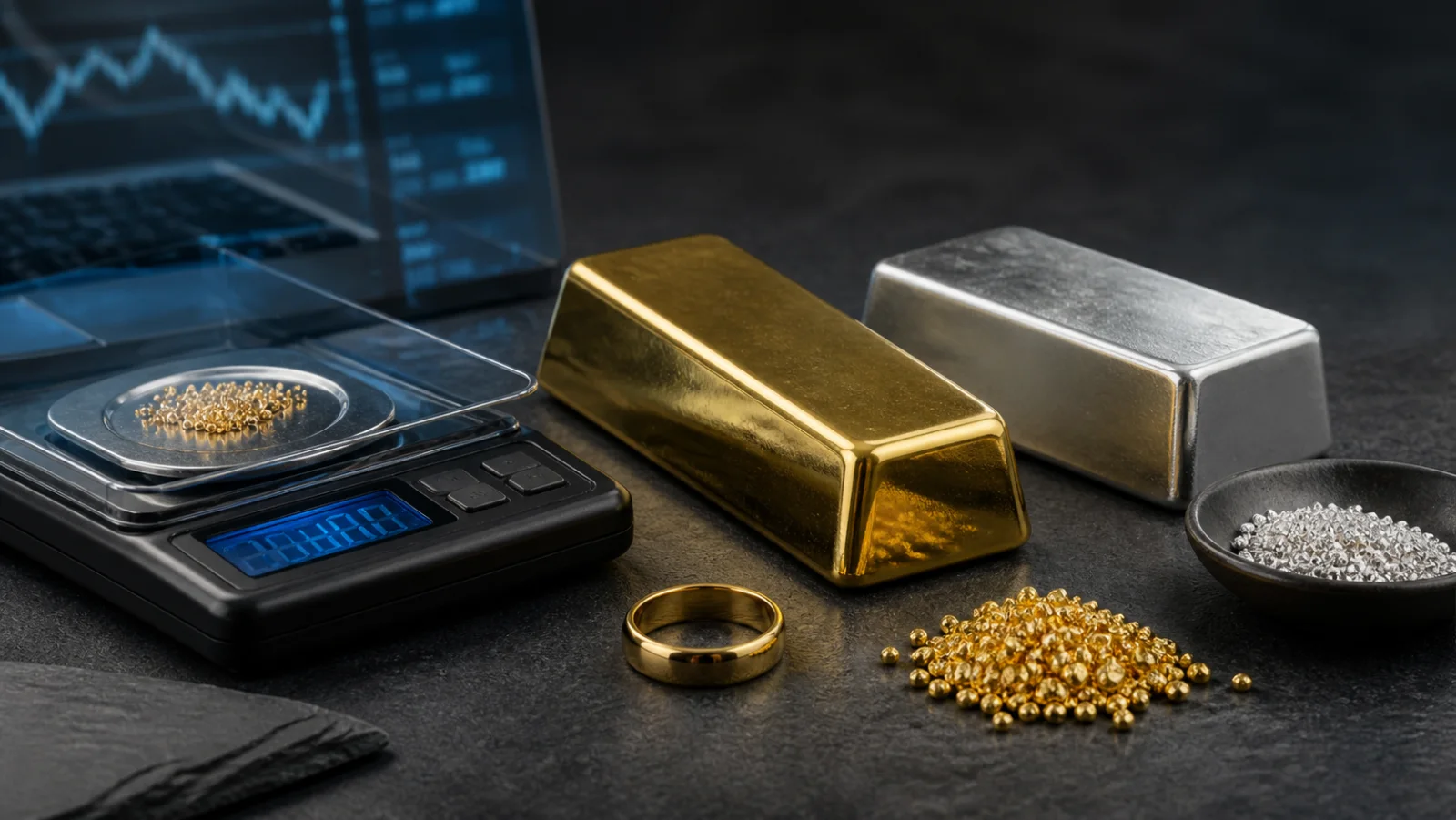
The three inputs that determine gold value
A sound gold-value estimate starts with three verified inputs: the item’s weight, its gold purity, and a current market price expressed in the same unit and currency. Missing any one of them can produce a result that looks precise but is economically meaningless. A 20 gram bracelet marked 18K, for example, contains materially less fine gold than a 20 gram 24K bar.
This calculation estimates intrinsic metal value, often called melt value. It does not automatically capture workmanship, rarity, brand value, collectability, gemstones, taxes, shipping, or a buyer’s margin. Those features belong in a separate appraisal rather than being mixed into the metal formula.
Step 1: confirm the weight and unit
Use a calibrated scale and record whether the result is in grams, kilograms, pennyweights, ordinary ounces, or troy ounces. Precious metals use the troy system: one troy ounce is exactly 31.1034768 grams. An ordinary household ounce is lighter, so treating the two ounces as interchangeable overstates or understates value.
If your quote is per troy ounce and your item is weighed in grams, divide the ounce price by 31.1034768 to obtain the pure-gold price per gram. If the item is weighed in kilograms, multiply the per-gram price by 1,000 or convert kilograms to approximately 32.1507465 troy ounces.
Keep every input in one unit before multiplying. Most avoidable gold-calculation errors are unit mismatches.
Step 2: translate karat or fineness into purity
Karat expresses how many parts out of 24 are gold. The mathematical purity factor is karat divided by 24: 24K is approximately 1.000, 22K is about 0.9167, 21K is 0.875, 18K is 0.750, and 14K is about 0.5833. Fineness marks express the same idea in parts per thousand, such as 750 for 18K or 999 for fine gold.
A hallmark is useful evidence, but it is not a substitute for professional testing when a transaction is significant. Solder, clasps, stones, internal components, wear, plating, or an inaccurate mark can make the recoverable fine-gold content differ from a simple whole-item calculation.
Step 3: use a current spot price
The spot quote is the benchmark price for wholesale gold at a stated moment. Use a source that displays its timestamp, currency, and unit. Because gold and foreign-exchange markets move, combining yesterday’s metal price with today’s currency rate can create a hidden mismatch, especially when converting a USD quote into MAD, EUR, GBP, or another currency.
The gold page on exchange-rate.live shows the source, price timestamp, freshness status, and equivalent values per troy ounce, gram, and kilogram. Its calculator applies the selected purity factor to the same verified quote, which keeps the inputs internally consistent.
The gold melt-value formula
For an item weighed in grams, the formula is: weight in grams × pure-gold price per gram × purity factor. If a hypothetical pure-gold price is $100 per gram, a 12 gram 18K item has an estimated melt value of 12 × $100 × 0.75 = $900.
For a troy-ounce calculation, use: weight in troy ounces × spot price per troy ounce × purity factor. The logic is identical. Round only the final result; rounding the unit conversion or purity factor too early can create a noticeable error on larger weights.
Worked example in a non-USD currency
Suppose the live price is quoted in USD but you need an estimate in Moroccan dirhams. First convert the USD gold quote to MAD using a current USD/MAD mid-market rate. Next convert the per-ounce quote to a per-gram quote. Finally multiply by the item’s gram weight and purity factor. Write down the two timestamps so you know whether the metal and currency inputs describe the same market window.
For example, if the converted 24K benchmark were hypothetically MAD 1,000 per gram, 25 grams of 21K gold would have an indicative melt value of 25 × 1,000 × 0.875 = MAD 21,875. This is an educational example, not a current quote; the live calculator should supply the market inputs.
Why a dealer offer differs from melt value
A dealer buying scrap gold cannot usually pay the full theoretical melt value and remain in business. The item may need to be tested, transported, insured, refined, and hedged against price changes. The buyer also faces uncertainty about recoverable purity and may quote a spread to cover those costs and risks.
Compare offers as a percentage of the same independently calculated melt value. Ask whether stones and non-gold components were removed from the measured weight, how purity was established, whether fees are deducted later, and when the quote expires. A transparent buyer should be able to explain the calculation in plain language.
A practical verification checklist
Before accepting a valuation, confirm the scale unit, record the gross and net metal weight, photograph visible hallmarks, verify the purity assumption, note the live price and timestamp, and calculate the result independently. For valuable, antique, branded, or stone-set pieces, obtain a qualified appraisal because melt value may be the least important part of the item’s market value.
Treat online calculators as estimation tools. They are excellent for establishing a benchmark and comparing quotes, but they cannot authenticate an item, measure hidden components, grade gemstones, or assess collectability. The final transaction price is a negotiated market price, not a guaranteed output from a formula.
Frequently asked questions
How do I calculate gold value per gram?
Divide the live price per troy ounce by 31.1034768, multiply by the item’s weight in grams, and then multiply by its purity factor.
What purity factor should I use for 18K gold?
18K gold is 18 parts gold out of 24, so the standard purity factor is 0.75.
Is melt value the same as resale value?
No. Melt value estimates the fine-metal content. A resale offer can also reflect testing, refining, dealer margin, collectability, workmanship, gemstones, taxes, and local demand.
Can I use a normal ounce for gold calculations?
No. Precious-metal quotes use the troy ounce, which equals exactly 31.1034768 grams and is different from the ordinary avoirdupois ounce.
Sources and methodology
This educational article uses unit standards and market context from the following primary or specialist sources. Worked prices are hypothetical unless explicitly identified as live data.